Sunday, 26 July 2015

You Are Affecting The System

Whenever a system is affected by an outside agent, its total energy changes. In general, a force is anything that causes a change. When a force causes a change in the energy of a system, physicists say that work has been done.  It is this work, this change in energy that has most recently caught my attention.  For it is my own work, my own energy that has changed and the outside agent that has caused this transformation is you.  You, the members of Twitter.

Yes you have changed me, my energy and my work for being a teacher.  You, this outside agent, have affected my energy for teaching like little other before you.  Admittedly, as I lay here thinking about how best to describe the influence people like you have had on my professional learning, this seemed like a pretty intellectual metaphor, an original thought.  But it turns out, as I searched further into the role change plays in various systems, I found another man for whom I have a great respect, had used a similar metaphor first.

Division Principal, Leadership Consultant, Ed Blogger and "change agent" to many of us, George Couros wrote eloquently in his blog The Principal of Change on the opportunity change gives and how our students can benefit from it (side note: while writing this post his brother and ed leader Alec Couros just followed me...crazy).  While our outside agents may have a different focus within our posts, the reality is that both our systems had changed as a cause of them.  While this area is of great interest to me, I will say thank you to George and get back to You now.


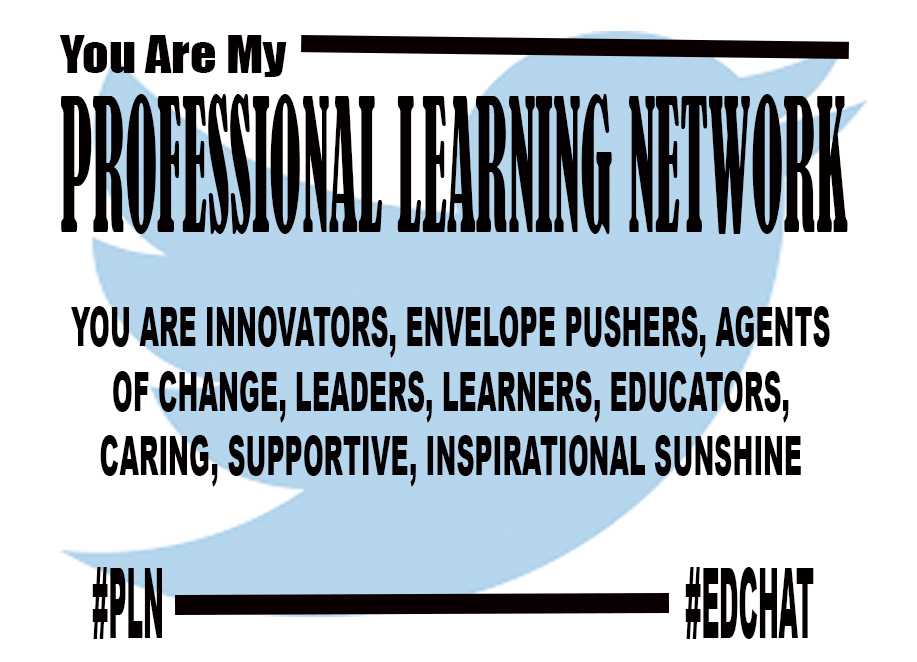
You are my Tribe, my educational army, you are my outside agents.  Why you?  Well as we indirectly share and support each other randomly through in a 140 characters or less, or directly through inspiring #edchats you are changing me.  You energize and inspire me to new and innovative ways of approaching education.  You provide guidance and I can turn to you for support at any time.  You showed me that there are others who care as I do and want to push the envelope.  You value and accept my passions and opinions.  Through you not only has my Technological competency grown, but so has my Pedagogical and Content Knowledge as well.   You are my Professional Learning Network and I thank you.

I remember when we first met, not at a school or some seedy bar, but on Twitter.  I was at a conference and these two great guys Tom Whitby and Steven W Anderson told me about you. I was naive to the power this platform held, but they were speaking my language and so I listened to them. It was a pretty overwhelming place with roughly 350,000 tweets sent every minute.  But then I started to find you, my Sherpas, and I followed you and began to learn.  I had begun to change.  After following you for a while, I felt confident enough to share my voice and soon you began to follow me too.  
I have driven my family to the brink of insanity with my regular sharings of new strategies and ideas I am learning.  The phrase "did you know?" or "this year I NEED to" escape my lips regularly.  You have really ignited what was already a pretty significant fire in me.  
The power of our network is evident, when #edchats are regularly trending and according to Twitter's number over 1% of all tweets are education related.    
While researching the Characteristics of Effective Professional Development, collaboration and self-directed learning were of great importance in all the articles I read.  The feedback on this topic I received seemed to support this as well as the advent of apps like Tweechme supporting #edchats and teacher involvement on Twitter.  This growing community we are all a part of is something special and has become an integral part of self-directed learning for hundreds of thousands of teachers around the world.  We are a global community affecting change on our systems and the systems of those we are connected to.

You are my 297 members and growing PLN.  You are my professional learning and inspiration.  You are my Sherpas and followers.  You are the change.


Saturday, 25 July 2015

THE ALTERCATION OF COMMUNICATION: PROFESSIONAL BLOG VS CLASS WEBSITE


As a fulltime teacher, elearning specialist for a university, a student, a coach, a tutor, a Twitter junkie, and a father it doesn't leave a lot of time left for things like sleeping, let alone the upkeep of multiple forms of social media. Initially the thought of this responsibility seemed daunting and repetitive. Fortunately, I don't sleep much and I recognize the necessity of a professional blog and a class website to help support my school community and my own professional growth.  So why do I blog and how do I use my class website?


Thursday, 23 July 2015

The Necessity of Designing Effective Professional Learning For Teachers

As my thoughts turn to next year and I begin to think about the areas of personal growth I would like to set goals for, I am reminded of a conversation that I was part of and that to this day still troubles me. In a discussion once with a teacher concerning PD(professional development), they made very clear that "they did not need to do anymore professional learning as they never get anything out of it." This alarmed me, and was followed by my awkward smile and nod of the head.  Was it in fact that this teacher really knew all that was needed to be an effective teacher or had they just not been part of an effective PD experience that left them wanting more?

According the Ontario College of Teachers, "The Standards of Practise for the Teaching Profession provide a framework of principles that describes the knowledge, skills, and values inherent in Ontario's teaching profession." Furthermore,these standards convey a collective vision of professionalism that guides the daily practises of members of the Ontario College of Teachers.  The College dictates,
"members recognise that a commitment to ongoing professional learning is integral to effective practise and to student learning. Professional practise and self-directed learning are informed by experience, research, collaboration and knowledge."
So then if we are mandated as Ontario educators to "ongoing professional learning, what was it that lead this teacher to feel otherwise?  If it was in fact a lack of experiencing effective professional development, what then are the characteristics of effective PD so that to ensure an intrinsic need in all teachers to be lifelong learners?

After doing a considerable amount of reading on the subject, talking to other educators and reflecting on my own experiences, I have found four common characteristics that seem necessary to make professional learning effective.  Effective professional learning is:

Collaboration: Teachers who work together have a team to discuss concepts, skills, and problems that arise during their professional development experiences over time. Second, teachers who are from the same school or grade are likely to share common curriculum materials, school/Area focus and assessment requirements. Finally, teachers who share the same students can discuss students' needs across classes and grade levels and By collaborating integrate what they learn with other aspects of their instructional context.


Data Informed: From most of the writing on the subject, there appears to be two main types of data to consider, Professional Research and Student.  Opportunities to collaboratively explore, implement and debrief on the findings and strategies of professional resources and research is an integral part of professional learning. Teachers are able to draw the skills of area specific experts into their own practise and increase student success through these strategies. Secondly, student data informs our programming, our pedagogical approach and the success of current practises.  Teachers must be given an opportunity to actively learn using student data to influence further professional learning and instructional practise.

Sustained Commitment: The research shows that one day PD event has little overall influence on a teacher's effectiveness in the classroom. Designing professional learning around the Continuous Improvement model, illuminates the necessity for supported long-term professional learning.  Collaboration with with peers, access to modelling and coaching, reflection and debriefing are all attributes of this cycle and known to promote student success through better instructive practises.

Adult Learning Theory: At the heart of all all of these characteristics is Knowles' Adult Learning Theory.  According to Knowles, Adults are more likely to invest in their learning if four key principles are involved.  Adults need to have a voice in the decision making around their professional learning.  Meaningful self-guided learning in the digital age is becoming more and more possible and educators are able to access greater resources online than ever before. Adults are able to design their learning to fit their specific needs. Adults prefer problem based learning and react better with goal setting than content retention.  Through exploring exemplars of successes and failures and actively experiencing these trials, adults are more likely to become actively involved in their learning.

Final Thoughts...
With the advent of Twitter and other platforms for creating worldwide PLNs that support professional growth and understanding, perhaps we are entering an age where professional development will become more self-guided and more meaningful, which may sway the opinions and practise of teachers like the one I mentioned earlier. The data is showing that this kind of professional development not only makes teachers have a greater investment in their practise, but it also promotes greater success for students.  Creating a profession of teaching in which teachers are the designers of their learning and are provided with the opportunity for meaningful continual collaboration is the likeliest way to achieve student success together.

Sunday, 19 July 2015

ASSISTIVE TECHNOLOGY: An Interview on Programming for All Students


CASSANDRA AHMED
Learning Resource Teacher
Prince Philip Public School, DSBN
Dual Track - English and French Immersion
Grades 3-8


Discuss Your Approach To Teaching and Supporting Students in Your Role as LRT?
Having worked with a variety of special needs children prior to becoming an educator, the importance of DI(differentiated instruction) and UDL(universal design for learning) are a big part of my planning.  While I realize these approaches support all students, having experienced environments where these were not principles of practice, I am aware of how important a role they play for my students.

What Role Does Technology Play in Supporting Your Students? 
It has been my experience that there are many ways in which technology benefits identified students. My students, like their classmates are drawn to technology and it motivates them to engage in their learning. With the aid of technology, it allows our teachers to work with more students at one time, it provides an equal playing field in education for special needs students and perhaps most importantly it helps build confidence and helps these kids find success.

How Does Tech Support Specific Needs of The Students You Support?
My students with mild cognitive disabilities in Reading, use reading skill support software, text-to-speech programs, interactive storybooks, etc. For those with mild impairments in Writing, use voice recognition and word prediction software. For students with physical disabilities provide alternate methods of access and train the students so they are able to work independently.  For students with sensory disabilities such as hearing impaired students, use assistive listening devices like FM amplification systems.

For students at-risk of learning, I've used software and websites that provide motivating opportunities to engage in learning activities and electronic quizzes that provide immediate feedback on performance.  Games with badges, points and tasks seem to really get these kids to buy in.  Some days, our goal is to simply participate other days we set the bar higher.  Self-efficacy plays a big role in the success of this group.

Outside of their additional programming off-site, for my students who are identified gifted, I try to find real world problems in areas of interest to launch them into content with appropriate challenges online. I also provide tools for engaging in self-directed research and tools such as multimedia presentations, web page design, and electronic portfolios to document learning experiences using Desire2Learn.  This is a large group in our school, which I believe is fairly unique.  It is an area of special education that isn't as often considered, but the demands of our population make this a significant part of my role.

What Is In Your Teaching Toolbox?

What Role Does Technology Play in Supporting Your Teachers? 
This is an area that I feel I have really integrated technology effectively. To begin, all our teachers have a shared schedule of mine in which they have scheduled times for support, but can also schedule me to come in for a specific class as well.  This has really given our time together purpose as they are planning with me in mind.  I then created shared profiles and learning documents on each student that I share with their teacher using GAFE.  It allows the teachers and I to collaborate, share information and update on how things are going in class or what I am working on with the student.  It has enabled me to really get a good perspective of the student and the teachers and I work in tandem to support them.

The first four are pretty standard in the toolbox of most learning resource teachers.  They work and with a little training are student friendly as well.  The last two are my most recent areas of growth over the last year.  Using Educreations, I have been designing lessons and sharing the videos with the students via D2L.  This enables them to review the learning and reinforces the strategies they developed.  It also provides home with the specific focus of the day, so to further their child using the same techniques used at school.  The read&write extension is also becoming a real interest of mine as well.  It is not only integrated directly into the programs and browser we have the students using at school, but it is available for access anywhere and it is free.  This has the potential to be a game changer for supporting students who aren't identified, but benefit from the support provide by this tool. 

That is the thing about many of the supports we develop for our identified students, they benefit all students and that is good programming for success. -Cassandra Ahmed

At A Glance: Universal Design For Learning


Universal Design for Learning is a set of principles for curriculum development that give all individuals equal opportunities to learn.  UDL provides a blueprint for creating instructional goals, methods, materials, and assessments that work for everyone--not a single, one-size-fits-all solution but rather flexible approaches that can be customized and adjusted for individual needs.
Individuals bring a huge variety of skills, needs, and interests to learning. Neuroscience reveals that these differences are as varied and unique as our DNA or fingerprints.

As stated, UDL acts as a blueprint for educators to create all that goes on in the classroom including the design of the classroom itself.  Furthermore, as the digital classroom becomes more and more popular, UDL as a guide for planning our blended and elearning approach as well.  Below is a detailed graphic on how educators can ensure that these principles are integrated throughout their program.


To clarify what this may look like in your classroom, I have outlined the following examples below of each of the three principles of UDL:

Provide Multiple Means of Representation
  • Offer alternatives for auditory and visual information
  • Offer ways of customizing information
  • Provide options for language, expression of information and symbols
  • Illustrate using a variety of media
  • Guide information processing 
Multiple Means of Action and Expression
  • Variety of response methods
  • Optimize access to assistive technology and tools
  • Variety of media types available for communication and composition
  • Build fluency with graduated levels of support
  • Support and guide student goal setting, planning and strategy development
  • Facilitate management of resources and information
Multiple Means of Engagement (we at engagementEDU are partial to this one :) )
  • Foster collaboration through community and minimize threat and fear
  • Vary demands and resources to optimize challenge
  • Promote a community that optimizes motivation
  • Facilitate personal coping skills
  • Timely and meaning feedback to develop self-assessment and reflection
  • Optimize individual choice
The wonderful thing about UDL is not just that supports our identified students, but that it supports all students.  It is a blueprint to create the most optimal environment and program for our students to achieve success.

Assistive Tech in The Primary French Immersion Classroom: Student Success with read&write for Google


To Listen to This Blog Post Follow The Directions Below:

When the Read&Write for Google extension is installed and you open a web page, you will see the Read&Write for Google icon next to the Bookmark star on the Google address bar (see image below). 


Click on the icon and the Read&Write for Google floating toolbar (see Image below) will appear. Click the tab again to hide the toolbar.


Click on the Hover Speech button that looks like a speech bubble with a cursor and then click beside the start of the next paragraph.

Assistive Technology(AT) can address many types of learning difficulties. A student who has difficulty writing can compose a school report by dictating it and having it converted to text. A student with dyslexia may benefit from AT that will read aloud instructions for an assignment.  An FSL or ELL student could access a story in the language they are learning with visual and audio support. There is a myriad of "text to speech" assistive technology available to our students nowadays, but  is so much more than that.  With this program our French Immersion students can:

Listening
Read&write for Google can help people who have difficulty processing and remembering spoken language. Such devices can be used in various settings (e.g., a class lecture, or a meeting with multiple speakers).
  • Hear text read aloud with dual color highlighting (consider online books or pdfs for read along in French Canadian accents)
  • Have words explained with text and picture dictionaries and translated into other languages (french vocabulary building within a contextual piece)
Reading
Read&write for Google help individuals who struggle with reading. While each type of tool works a little differently, all of these tools help by presenting text as speech. These tools help facilitate decoding, reading fluency, and comprehension.
  • Simplify and summarize text on web pages (reduce the subject matter/language level problem by enabling age appropriate content to become accessible) 
  • Have words explained with text and picture dictionaries and translated into other languages (french vocabulary building within a contextual piece)
Writing
Read&write for Google help students who struggle with writing. Some of these tools help students circumvent the actual physical task of writing, while others facilitate proper spelling, punctuation, grammar, word usage, and organization.
  • Get suggestions for the current or next word as you type with Word Prediction (developing grammar and written second language skills) 
  • Turn speech to text in Google Docs (enabling students to share their understanding in French) 
  • Highlight and collect text; build vocabulary lists (vocabulary development and home to school support)
While this post was written from a Primary French Immersion lens, the applications for read&write for Google support all students and all student abilities.  This extension is more than just another great tool in the GAFE toolbox.  It is an opportunity for teachers and parents to provide children with accessibility to information, a method for sharing their voice and vehicle to promote self confidence.  

Sunday, 12 July 2015

IT TAKES A VILLAGE: Communication From A .COMmunity

The term "lifelong learner" has become such commonplace in education that it had lost it's impact for me.  However, the clarity of mind that Summer can lend, has really reminded me of how inevitable for me being a lifelong learner really is.  The more time I spend interacting with my ever growing digital PLN on Twitter, the more I realise how much I still need to learn.
The mass wealth of knowledge and experience, #edchats that take place across the world and the willingness of the community to support those looking to learn is overwhelming...but in a good way, no scratch that, in a GREAT way!
So when seeking to support for my colleagues, fellow lifelong learners and those new to the profession, I reached out to my PLN and asked for their advice.  I built a simple questionnaire in Google Forms, designed to elicit targeted responses on edtech, professional learning, and leadership.  I then set to sharing it with people who I felt were educational innovators, the kind of people I get pumped from just listening to.  The kind that when you come away from a conference with them, you feel invigorated and ready to do great things.  It didn't take long, and those kind of people started to respond.  The following is their shared wisdom.

Meet Our AMAZING Panel of Educators

Pernille Ripp @Pernilleripp
Intermediate Teacher, Creator of the
Global Read Aloud, Author and Speaker


Marylee Ang-Sadecki @MaryleeAng
Instructional Media and Edtech Consultant for
The Calgary Catholic School District

Connie Hamilton @ConnieHamilton
Principal, Classroom Questioning Trainer/Consultant
and Curriculum Director at Saranac Community Schools

Tom D'Amico @TDOttawa
Teacher, Administrator and Associate Director of Education of
Ottawa Catholic School Board


Please tell me a little bit about your experience in Education?

Pernille: It has been one of incredible highs and lows. From teaching 4th grade and taking risks in the way I taught to teaching 7th graders and having to re-think everything, there has not been a dull moment.

Marylee: I have been an educator since 2006. I have taught various subjects: Social Studies, English Language Arts, Computers and Art in Junior High and High School. I recently completed my Masters in Educational Technology which transitioned my teaching position to a consultancy in Instructional Media Educational Technology.

Connie: I have taught early elementary, 8th grade ELA, and Title I. As an administrator, I've been MS asst. principal, MS principal, Elementary principal, and curriculum director.

Tom: I have been with the Ottawa Catholic School Board for 25 years. I began as a physical education teacher and then became the department head of business and computer studies. I was a vice-principal, principal, superintendent of learning technology, superintendent of human resources, and am currently the Associate Director of Education.

How do you view the role of technology in education?

Pernille: As something that can bring our students' voices and thoughts into the world. It should be used to deepen a lesson, not as an add-on

Marylee: I think it is important to embrace the role that technology can bring in education. It has the power to transform learning with teachers and students. However, I also believe it is even more important to put pedagogy before the tool. It needs to be meaningful, and move from consumption to creation.

Connie: Technology is a tool that educators can use to provide innovative ways to support student learning

Tom: I view technology as an important tool that can be leveraged to help engage students and to provide opportunities for deeper learning and global connections.


What is one edtech tool you would always want in your toolbox and why?

Pernille: Twitter, because it keeps me connected and in tune with what is happening in the (ed) world

Marylee: I have always been a fan of Twitter. For educators especially, it allows a more personalised approach to personalising their professional development.

Connie: Google Apps. Google Apps provide a variety communication/organisation tools for both students and adults.

Tom: The suite of Google Apps for Education has had a major impact on teaching and learning in our school Board. Our District supports over 40,000 students and the introduction of Google Apps for Education in 2010 has fostered collaboration and creativity throughout our district. The use of real-time collaboration features, along with google communities, google hangouts, and the many other tools in the Google Suite has opened up our classrooms to a much larger community for learning and teaching.

What is an important lesson you have learned through utilising technology in educating?

Pernille: That it is not about quantity of tools but rather what you choose to use.

Marylee: I have always used instructional design when incorporating technology in lessons. Understanding what the objective is, and working backwards. If the technology fits, then that is a bonus. Lessons should never be around technology, rather needs to be engaging, personal and relevant to students.

Connie: It doesn't always work the first time and there's always someone else who knows how to do it... just ask.

Tom: The most important lesson that I have learned is that good teachers and good pedagogy are the key to implementing successful technology initiatives. If a teacher uses a SmartBoard/LCD projector to project static notes and students use their iPads or Chromebooks to copy notes, we have not had any impact in the use of technology. We promote the SAMR model to look at leveraging technology to create new knowledge that was not possible without the current technological innovations.


How has technology influenced your professional learning?

Pernille: Immensely so, everything is at my fingertips and I can learn when I want to rather than wait for opportunities in my district

Marylee: Especially with Twitter, and attending many conferences, the backchannel has broadened my professional and personal learning. I learn best by what other educators are sharing and how it can better my practise.

Connie: Without tech I wouldn't be a connected educator. I wouldn't be able to share/collaborate with the ease I have now.

Tom: Technology has allowed me to participate in global learning communities and to learn and share with a broad range of educators. Examples include: @TDOttawa twitter account to share resources and to follow other; iGeneration Scoop-IT account to curate resources, and many webinars via organizations such as EdWeb.

What advice do you have for aspiring leaders in education?

Pernille: To ask the students how you can be a better teacher.

Marylee: Find your passion in education and never lose sight. At the heart of it - it is always about the students and that should never be forgotten.

Connie: Be connected. Your PLN is critical. It's a matter of not only what you know, but who you know.

Tom: Focus on pedagogy first and then leverage technology to engage your students and make global connections. Use technology for assessment for learning so that you continually monitor and modify your teaching strategies to meet the unique needs of each learner in your class. Have fun, make mistakes, learn from your mistakes, and realise the impact you are having on a great generation of learners.

In Conclusion...

Firstly, I feel so very thankful to have received the responses that I did.  The kindness of the contributors was overwhelming and we are fortunate to be learning from their experience.  The Panel was created from various areas within education and their different roles came through in their fantastic responses.  While varied in their position and experience within education, there were some powerful commonalities amongst their responses.
  • Engaging and supporting students to achieve success is our greatest priority
  • Pedagogy before Technology  
  • Community is one of our greatest gifts.  Get connected.
Thank you again to the contributors, those who messaged me and to my PLN.  Through our supportive community, great things are happening.

Part of the transaction between writer and reader is the pleasure of building a community and encouraging people to play along.  -John Hodgman